





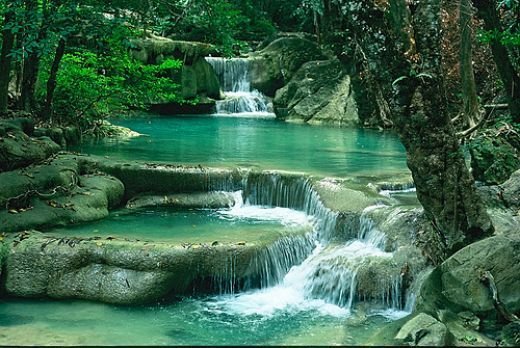

There is a moment every traveller in Laos eventually experiences. You have been walking forty minutes through dense jungle — humidity so thick it feels structural, insects replacing every other sound — and then the trees part. The roar arrives before the sight. A low, sustained thunder building as you move toward it. And then the jungle opens and there it is — white water dropping into a pool of such impossible blue-green that your brain initially registers it as artificial.
It is not artificial. Nothing in Laos is. That is precisely the point.
Laos is Southeast Asia’s most overlooked country and its waterfalls are its most overlooked feature. While Kuang Si near Luang Prabang has entered the tourist circuit, the country contains dozens of cascades receiving a fraction of that attention — accessible to travellers willing to go slightly further, stay slightly longer, and move at the pace the country itself suggests.
Why Laos Waterfalls Are Different
The waterfalls of Laos are products of a specific geography — the Annamite mountain range running along the Vietnamese border, Mekong tributaries cutting through limestone karst, and jungle coverage so dense that many cascades remain genuinely unknown outside the villages that have lived alongside them for generations.
The water quality is the first thing you notice. Fed by mountain streams filtered through limestone, the pools beneath Laotian waterfalls have a clarity and colour — turquoise shading into deep green in the shadows, lit from below on bright days with an almost supernatural luminescence — that photographers consistently describe as impossible to capture accurately. The photographs never fully work. The experience always does.
Kuang Si Falls, Luang Prabang — The Benchmark
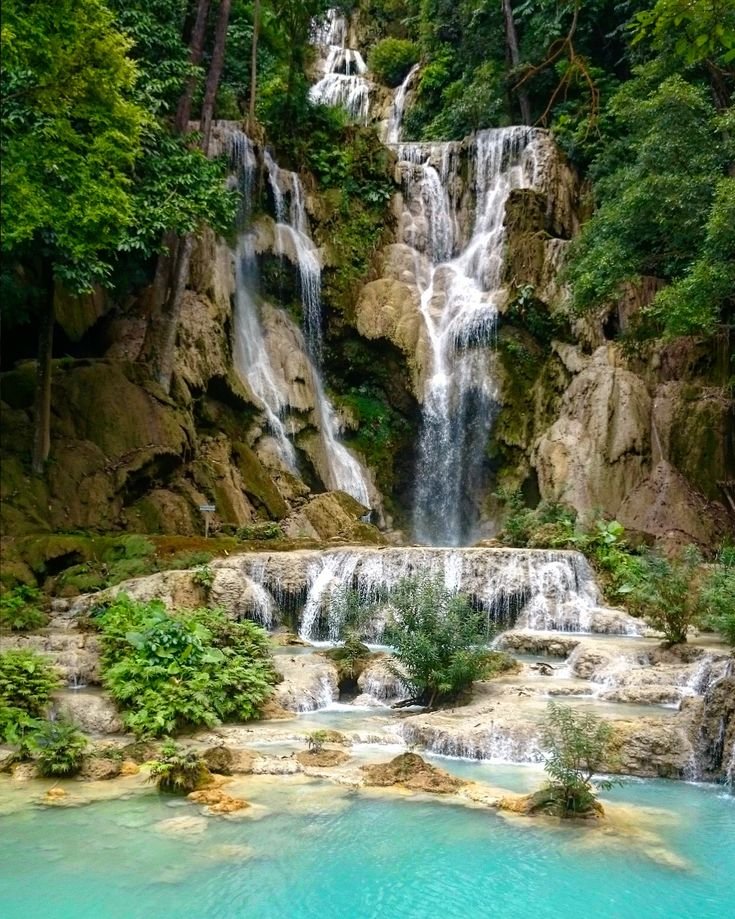
Any honest guide begins here. Thirty kilometres south of Luang Prabang, Kuang Si drops 60 metres through terraced limestone pools before reaching its main cascade. Each pool sits at a slightly different shade of turquoise depending on depth and light — and swimming in water this colour, this temperature, in a jungle this quiet, is one of the finest single experiences Southeast Asia provides.
Arrive before 8am. The light is better, crowds are minimal, and the pools belong almost entirely to you. By 10am the coaches arrive. By then, you should already be dry.
Tad Fane, Paksong — The One That Stops Conversation
In the Bolaven Plateau of southern Laos, Tad Fane drops 120 metres into a jungle gorge so deep and densely vegetated that the base is invisible from the viewing platform above. Twin falls — two parallel curtains of white water disappearing into green — create a spectacle that stops conversation among people who have been talking continuously since they met.
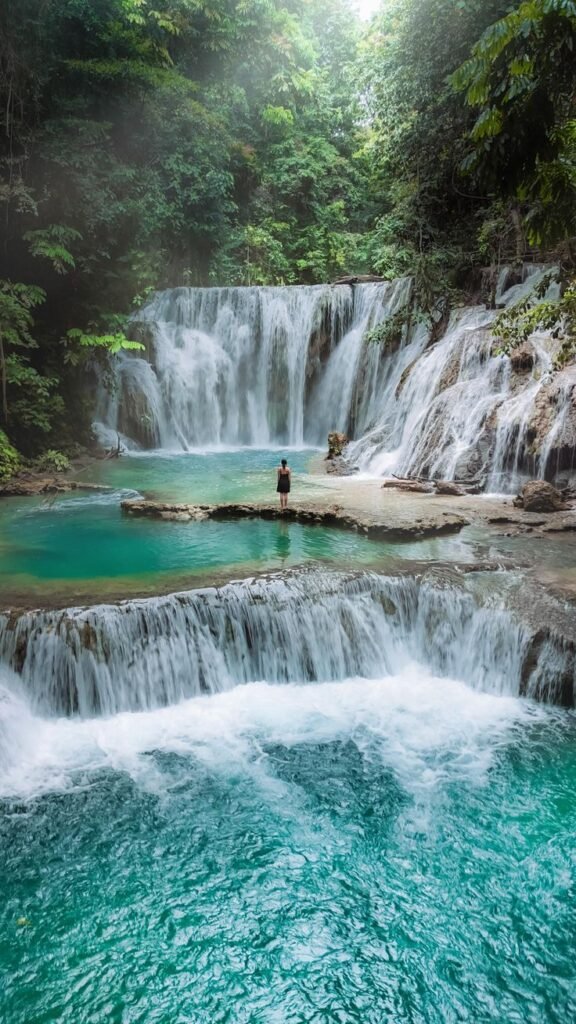
The Bolaven Plateau itself — a highland of coffee plantations, cool temperatures, and a dozen waterfalls accessible by motorbike — is one of Laos’s finest travel experiences. Rent a motorbike in Paksong, give yourself three days, and follow roads that look interesting rather than the ones on the tourist map. Tad Fane is the headline. The unnamed falls you find along the way are often the memory.
Tad Yuang — The Swimming Hole the Guidebooks Miss
Twenty kilometres from Tad Fane, Tad Yuang receives a fraction of its neighbour’s visitors despite offering something it cannot — direct access to the base. A steep jungle trail descends to a wide pool fed by a 40-metre cascade that creates a natural shower at its edge. The local family managing the site charges a nominal entry fee and sells cold drinks from a cooler on the bank. No restaurant. No gift shop. No queue. Just the waterfall, the pool, and the silence that falling water creates around itself.
Tad Lo, Salavan Province — Where the River Becomes the Resort
In Salavan Province, the Xe Set River cascades through falls known collectively as Tad Lo — a destination so unhurried that travellers who find it frequently extend their intended one-night stay into a week without entirely understanding how it happened. Three cascades at different heights surround guesthouses whose terraces directly overlook the river. Ethical elephant experiences and village walks through Alak and Katu communities add cultural depth to what is, at its core, a destination built entirely around the sound and sight of moving water.
Getting to the Water
Most of Laos’s finest waterfalls are accessible by motorbike — the transport mode that suits the country’s pace best. Daily rentals run $8 to $15 for reliable semi-automatics in Luang Prabang, Vang Vieng, and Pakse. Entry fees at most falls run between 50 cents and $1.50 — funding trail maintenance, swimming area management, and jungle conservation that makes every experience possible.
Dry season — November through April — offers the clearest water and most accessible trails. Wet season — May through October — delivers the most dramatic volumes but challenging jungle conditions. Both seasons have advocates. The honest answer is that Laos is beautiful in the rain.
The Country That Moves at Water Speed
Laos has resisted, by geography and temperament, the tourism acceleration that has transformed its neighbours. Its waterfalls are the purest expression of that character — unhurried, generous, genuinely beautiful, and indifferent to whether you photograph them well.
Go slowly. Stay longer than you planned. Follow the sound of water.
It will not lead you anywhere disappointing.
Explore our Destinations section for more Southeast Asia travel guides, hidden waterfall discoveries, and the travel intelligence that keeps you ahead of the crowds in 2026.