






Most hotels compete on thread count and view. Treehotel, hidden in a pine forest outside the small Swedish Lapland village of Harads, competes on something stranger: getting a different world-class architecture firm to design each individual room, then suspending the results several metres up in the trees. Since opening in 2010, it’s become less a hotel in the traditional sense and more an ongoing architectural experiment, one where every new addition gets treated as a genuine design event rather than a simple room expansion.
How a Guesthouse Became an Architecture Icon
Treehotel was founded by Kent and Britta Lindvall, who ran a traditional guesthouse on the same forested plot before deciding, in 2010, to reimagine it entirely as a collection of individually architect-designed tree rooms. The concept could easily have read as gimmick, a hotel built around a novelty premise that wears thin after the first stay. Instead, the Lindvalls kept commissioning genuinely serious architectural talent, Tham & Videgård, Snøhetta, Rintala Eggertsson, and eventually Bjarke Ingels Group, each bringing a distinct design language to a single shared brief: build something extraordinary in the trees, at a scale that respects the forest rather than dominating it.
The Mirrorcube: Nearly Invisible by Design
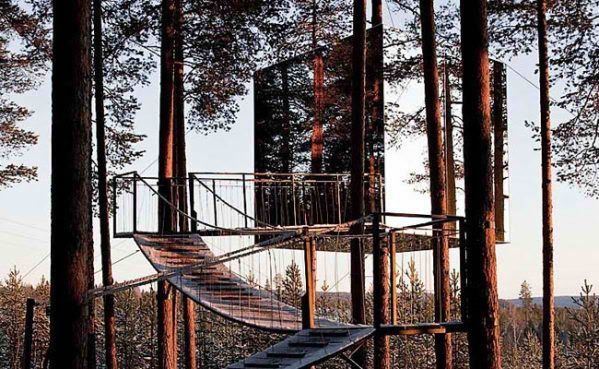
If Treehotel has a signature room, it’s the Mirrorcube, designed by Tham & Videgård, the architects behind Stockholm’s Concert Hall and Paris’s Denfert Building. The cube’s exterior is clad entirely in reflective glass, engineered to camouflage the structure into the surrounding pines so effectively that from a distance it nearly disappears, birds and all reflected back into the forest around it. Step inside, though, and the effect flips entirely: floor-to-ceiling glass turns the room into a 360-degree portal onto the treetops, with a hidden balcony tucked behind the mirrored walls offering an even more private vantage point above the canopy.
The Bird’s Nest: A Cocoon Built From Branches
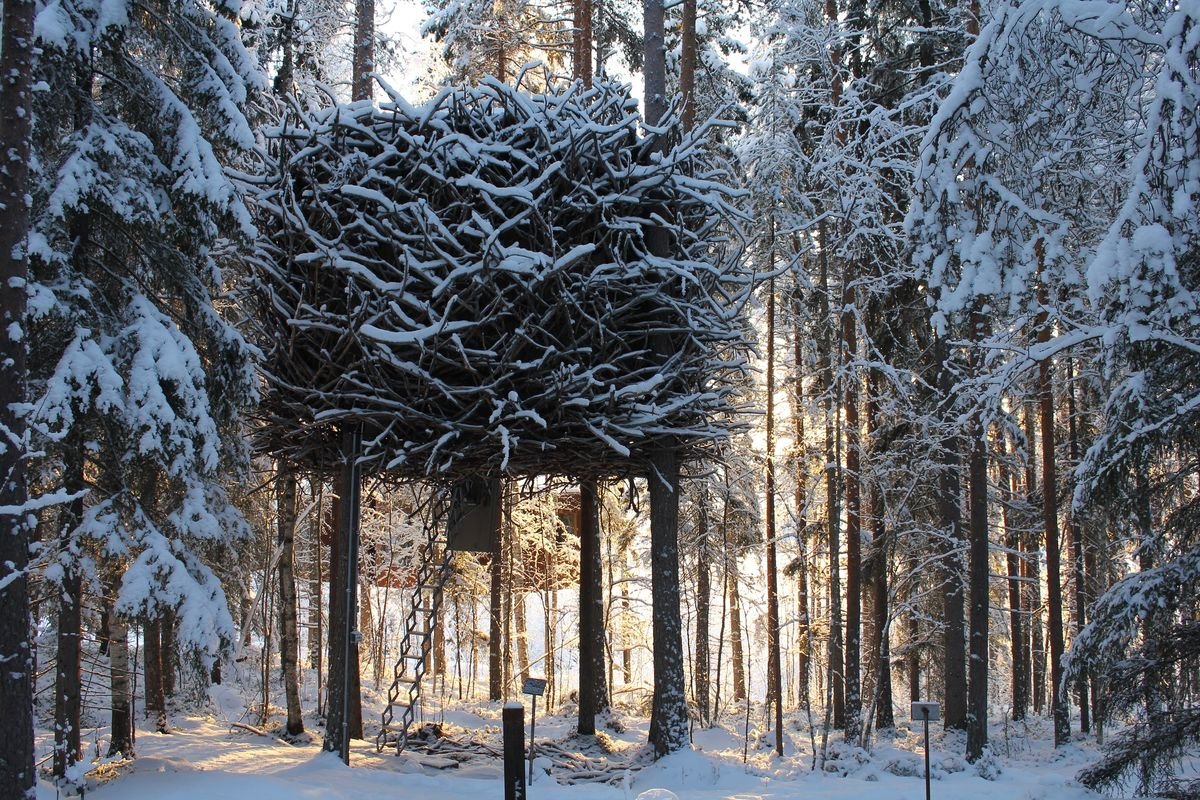
Where the Mirrorcube plays with reflection, the Bird’s Nest goes the opposite direction entirely, wrapping a genuinely cozy interior in a dense, deliberately chaotic lattice of timber branches that mimics an oversized nest clinging to the treetops. Sleeping up to four guests, it’s one of the more playful rooms in the collection, the kind of structure that looks improbable from outside and surprisingly warm and enclosed once you’re inside it. Alongside the equally whimsical UFO, a suspended disc-shaped cabin that tends to be a particular favourite with children, the Bird’s Nest represents Treehotel’s more theatrical, imaginative register.
Biosphere: Architecture Built for Birds as Much as Guests
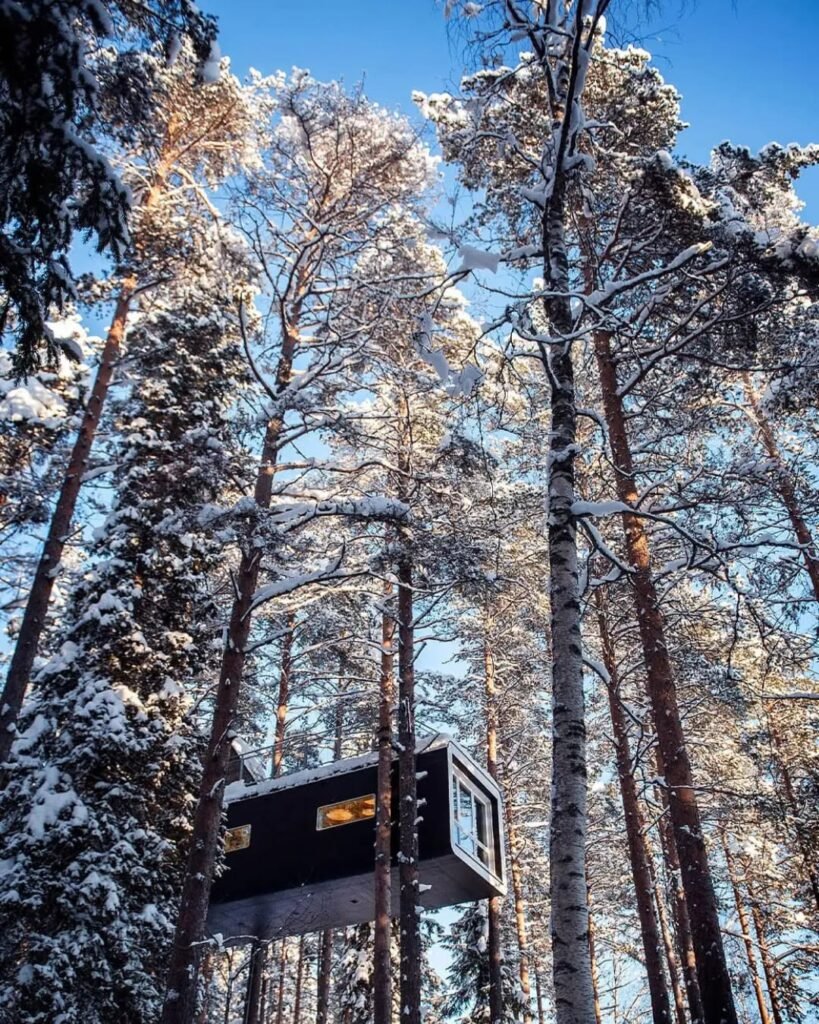
The newest and most ambitious addition is Biosphere, opened in 2022 as the hotel’s eighth room, designed by Bjarke Ingels Group in direct collaboration with Ulf Öhman, an ornithologist and chairman of the Norrbotten County Ornithological Association. The concept inverts the usual guest-first logic entirely: a 34-square-metre glass suite wrapped in 340 individual birdhouses sized to accommodate everything from tiny chickadees to jackdaws, designed explicitly to help counter local bird population decline linked to forestry and climate change. Guests reach the suite via a suspended footbridge and sleep surrounded by floor, wall, and ceiling windows looking directly out at nesting birds, with a rooftop terrace delivering a full 360-degree view over the forest and the Luleå River. Öhman has been clear that the design works both ways, birds don’t nest where they’d soil the glass, so the arrangement stays functional for both species rather than becoming a maintenance problem for one.
Planning a Stay
Treehotel sits roughly seventy to ninety minutes from Luleå Airport by car, itself a regional gateway reached via a flight or overnight train from Stockholm. Rates start around 880 US dollars for two people including breakfast, positioning it firmly as a splurge stay rather than a casual overnight, in line with its status as a genuine architectural pilgrimage rather than simple accommodation. Arrival itself is part of the experience: guests typically walk a short forest path from the historic main guesthouse to reach their tree room, a deliberate transition meant to leave check-in logistics behind before the design even comes into view.
Why It Keeps Working
Novelty concepts in hospitality usually fade once the initial curiosity wears off. Treehotel has avoided that by treating each new room as a genuine architectural commission rather than a repeat of what worked before, and by grounding even its most whimsical structures, the UFO, the Bird’s Nest, in real ecological and design intent, as Biosphere makes explicit. For travellers chasing something beyond a conventional Nordic lodge, Treehotel offers a rare thing in modern hospitality: a hotel where the room itself, not the view or the spa, is genuinely the destination.