





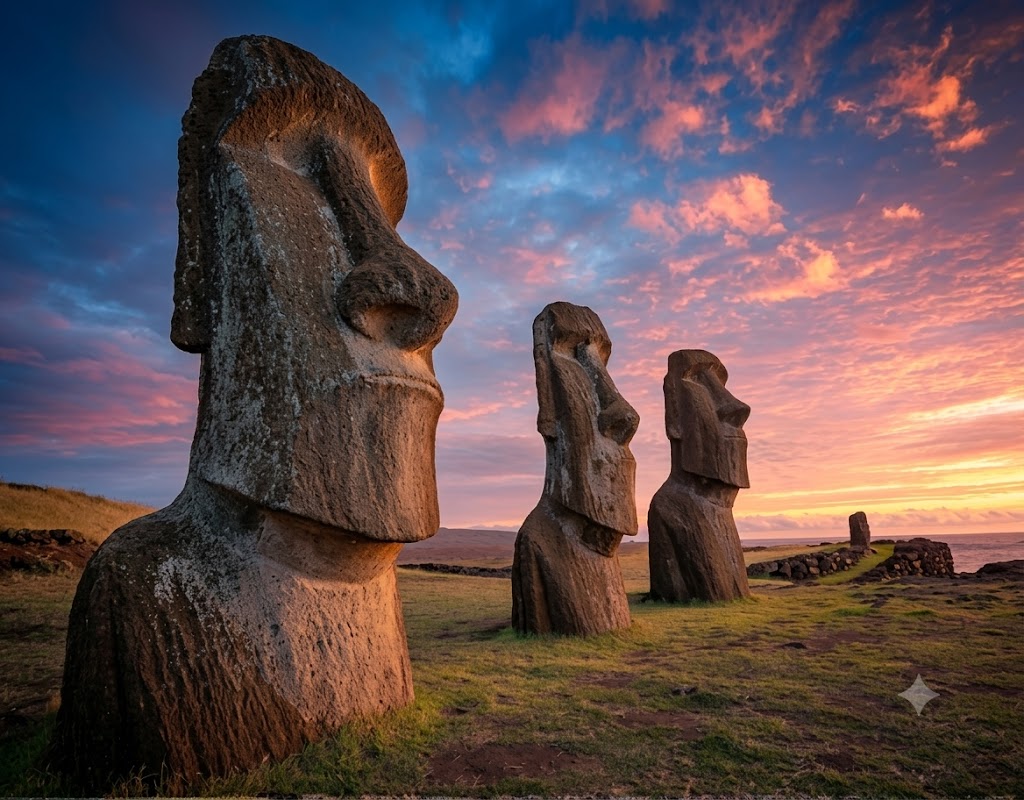

When most people think of Rapa Nui—better known as Easter Island—a single image comes to mind: giant, stoic stone heads staring silently across a grassy, treeless coastline.
Those monumental statues, known as moai, have dominated documentations, travel brochures, and archaeology specials for decades. But focusing purely on the carving and moving of these stone giants misses the far more extraordinary story happening right beneath their bases.
Sitting more than 2,100 miles off the coast of Chile in the middle of the South Pacific, Rapa Nui is one of the most isolated inhabited islands on Earth. That extreme solitude didn’t just challenge the Polynesian voyagers who settled here—it forced them to build one of the most ingenious, self-contained, and resilient societies in human history.
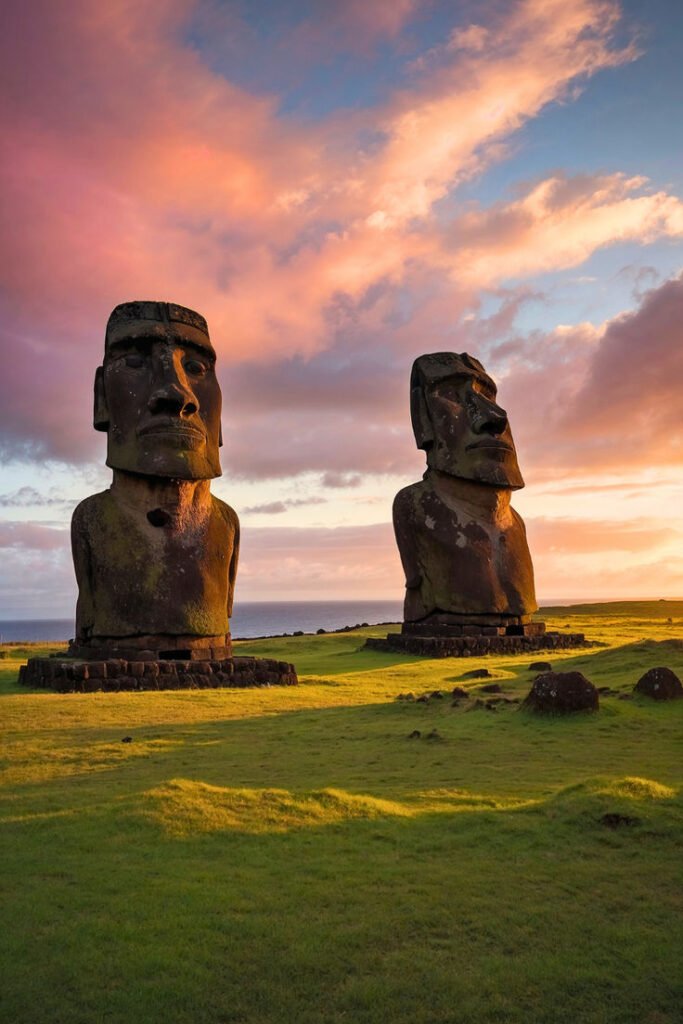
Survival on a Floating Volcanic Outpost
When the first Polynesian navigators arrived on Rapa Nui around 1,200 years ago in open-ocean double canoes, they didn’t land in a tropical paradise brimming with easy resources.
The island is tiny—roughly sixty-three square miles of volcanic rock—with no major rivers, unpredictable rainfall, and nutrient-poor soil. Once those early canoes landed, there was no going back, and there were no neighboring islands to trade with for supplies. Whatever the islanders needed to survive, they had to invent from scratch.
To solve the food problem, the Rapa Nui people developed a brilliant agricultural system known as lithic mulching.
They realized that breaking up volcanic basalt rocks and scattering them across their fields protected the soil from harsh ocean winds, retained precious rainwater, and slowly released essential minerals back into the earth. Entire plantation fields were deliberately covered in stone, allowing crops like sweet potatoes, taro, and sugarcane to thrive in an environment that should have starved them.
Rethinking the “Ecological Collapse” Myth
For years, popular history pushed a dramatic narrative about Easter Island: that the islanders recklessly chopped down every single tree on the island to move their moai, triggering a catastrophic famine and wiping out their own civilization.
Modern archaeological research, however, paints a vastly different and far more nuanced picture.
While deforesting the island did create severe environmental challenges, the Rapa Nui didn’t just curl up and disappear. Instead, they adapted. When the palm forests vanished—partly due to human clearing and partly due to invasive Polynesian rats eating tree seeds—the islanders completely restructured their society.
They shifted away from building massive stone platforms and developed the Birdman cult (Tangata Manu), an egalitarian annual competition centered around retrieving the first egg of the soot tern from a dangerous offshore islet. This new system redistributed political power among clans peacefully, replacing dynastic rule with a ritual based on physical endurance and skill.
The True Legacy of Rapa Nui
The real marvel of Easter Island isn’t that a small population carved multi-ton stone monoliths out of volcanic tuff—it’s that they maintained a complex, artistic, and peaceful society for centuries in complete geographic isolation.
They developed Rongorongo, one of the few independently invented written scripts in human history, carved into wooden tablets that scholars are still attempting to fully decipher today. They built sophisticated rainwater collection systems inside volcanic craters and engineered stone chicken coops (hare moa) designed to protect livestock from ocean gales.
Lessons from a Micro-Planet
Rapa Nui is often described as a microcosm of planet Earth. Floating alone in a sea of endless water, its inhabitants had limited resources, no external help, and nowhere else to go.
Visiting or studying Easter Island today offers a powerful lesson in human adaptability. The moai may be what draws our eye, but it’s the quiet ingenuity, agricultural genius, and cultural resilience of the Rapa Nui people that allowed a civilization to flourish at the very edge of the known world.