






In 1972, a newly crowned king made a statement that the world’s economists dismissed as charming but impractical. Jigme Singye Wangchuck — the fourth Dragon King of Bhutan — declared that Gross National Happiness mattered more to his kingdom than Gross Domestic Product. Five decades later, as the global conversation around wellbeing economics, mental health, and the limits of growth has finally caught up with that declaration, Bhutan looks less like a philosophical outlier and more like a country that simply understood something the rest of the world is still learning.
For travellers, Bhutan offers something rarer than spectacular scenery — and the scenery is genuinely spectacular. It offers a coherent alternative model of how a society can organise itself around human flourishing rather than economic output. Spending time here does not merely show you a beautiful country. It asks you a question about your own.
The Architecture of Gross National Happiness
Gross National Happiness is not a slogan. It is a governing framework built on four pillars — sustainable socio-economic development, environmental conservation, preservation of culture and heritage, and good governance — measured across nine domains including psychological wellbeing, time use, community vitality, and ecological resilience.
The framework shapes policy in ways that are directly visible to visitors. Bhutan maintains a carbon-negative status — one of only three countries on earth to absorb more carbon than it produces, with 72 percent of its land constitutionally protected as forest. Plastic bags have been banned since 1999. Television and internet arrived only in 1999, deliberately delayed to protect cultural cohesion. Tobacco sales are prohibited. Every architectural structure — from petrol stations to airport terminals — must conform to traditional Bhutanese design.
These are not tourist-facing performances. They are the physical expression of a governance philosophy that places cultural integrity and environmental health above economic efficiency.
The Hidden Valleys: Geography as Philosophy
Bhutan’s landscape is inseparable from its worldview. The country occupies the eastern Himalayas between Tibet and India — a terrain of dramatic vertical variation, from subtropical valleys at 200 metres to Himalayan peaks exceeding 7,000 metres, compressed into a country roughly the size of Switzerland.
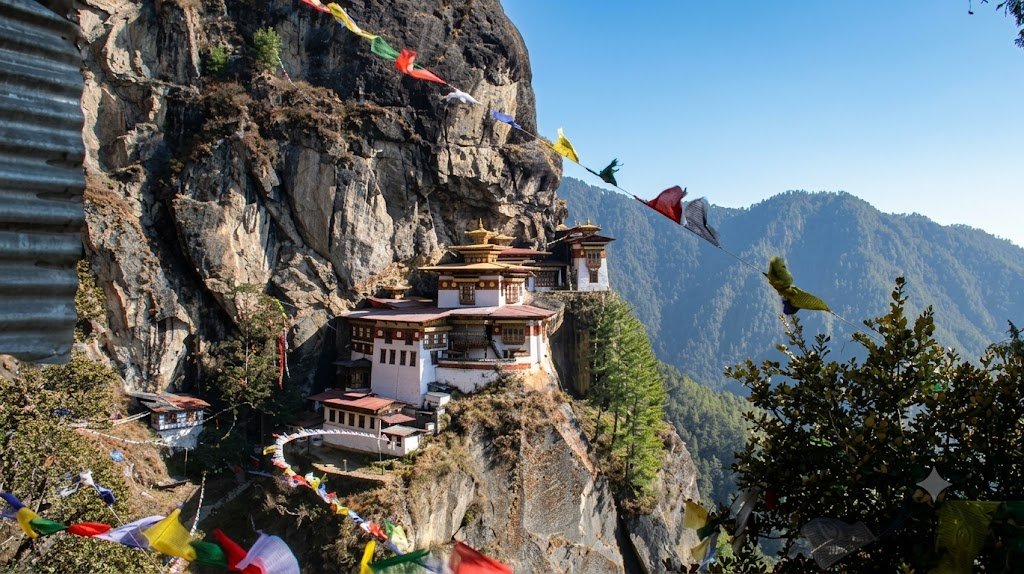
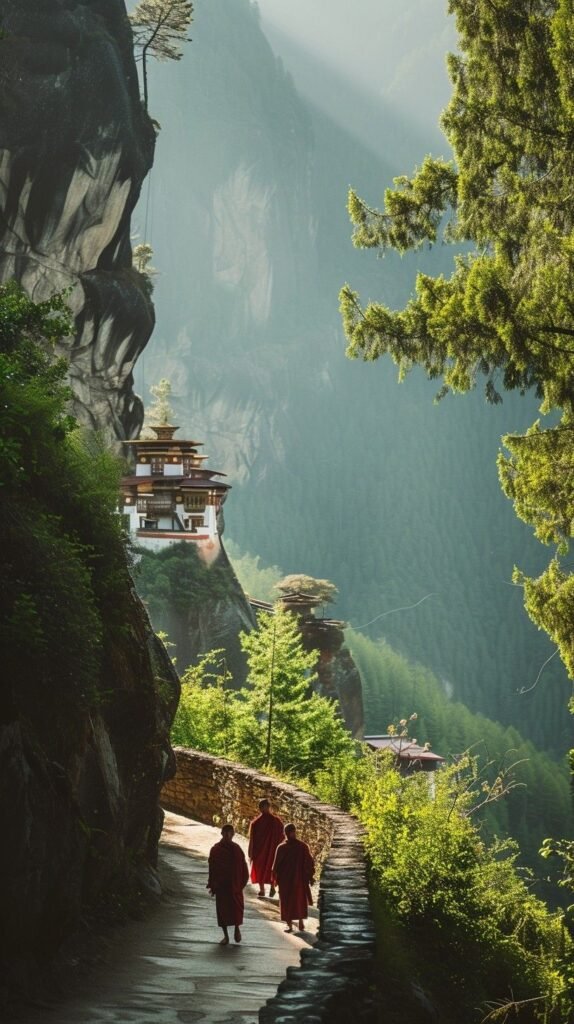
The Paro Valley — home to the iconic Tiger’s Nest monastery, Paro Taktsang, which clings to a cliff face 900 metres above the valley floor — is the country’s most visited destination and its most photographed. The monastery, built in 1692 at the site where Guru Rinpoche is said to have meditated in the 8th century, requires a two-hour hike to reach. That walk is not incidental — it is the point. Bhutan consistently builds effort into its most significant experiences.
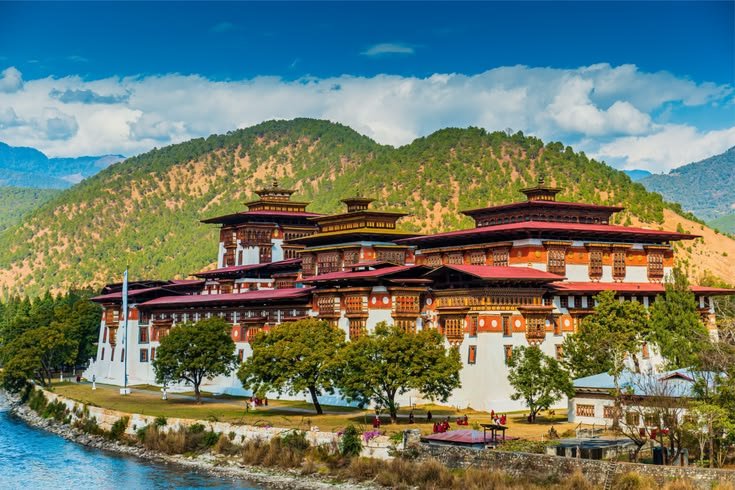
The Punakha Valley, two hours east of Paro across the Dochula Pass, is arguably more beautiful and considerably less visited. The Punakha Dzong — a fortress monastery at the confluence of the Pho Chhu and Mo Chhu rivers — is the finest example of traditional Bhutanese architecture in the country, particularly spectacular in February when the surrounding jacaranda trees bloom in purple against white-washed walls.
The Haa Valley, opened to tourists only in 2002, remains the least visited of the accessible valleys — a landscape of forested hills, traditional farmhouses, and nomadic yak herders that carries the particular quality of a place that has not yet organised itself around the expectation of being observed.
The High Value Low Impact Tourism Policy
Bhutan’s tourism model is deliberately restrictive — and deliberately so. Every international visitor pays a Sustainable Development Fee of $100 per person per night, a policy framed not as exclusivity but as sustainability. The fee funds free education, free healthcare, and infrastructure development while limiting visitor numbers to levels the ecosystem and culture can absorb without degradation.
This model inverts the conventional tourism economy. Most destinations compete for volume — more visitors, more revenue, more growth. Bhutan competes for value — fewer visitors who engage more deeply, spend more responsibly, and leave less damage behind. The result is a tourism sector that funds national development without the cultural erosion and environmental degradation that high-volume tourism consistently produces elsewhere.
In 2023, Bhutan received approximately 145,000 international visitors. Thailand received 28 million. The comparison is not a criticism of Thailand — it is an illustration of two entirely different philosophies of what tourism is for.
What Every Traveller Can Learn From Bhutan
Bhutan’s most exportable lesson is not its policy framework — that requires specific geography, history, and political will that most countries cannot replicate. Its exportable lesson is attitudinal.
The concept of enoughness. The idea that sufficiency — having enough, doing enough, seeing enough — is a more sustainable and ultimately more satisfying orientation than maximisation. Bhutanese Buddhist philosophy frames desire itself as the primary source of suffering, not as an engine of progress. The traveller who visits Bhutan and absorbs even a fraction of that reorientation returns home with a different relationship to their own consumption — of goods, of experiences, of time.
The second lesson is presence. Bhutan’s deliberate friction — the effort required to reach Tiger’s Nest, the limited connectivity in the valleys, the absence of the commercial infrastructure that most destinations use to fill every moment — forces a quality of attention that most modern travel has engineered away. You notice more. You think more. You remember more.
The third lesson is that a country can choose what it optimises for. Bhutan chose happiness. The choice is visible in every monastery, every protected forest, every valley that has been left alone because development was available and declined.
Practical Bhutan: What You Need to Know
Visa and entry — all international visitors except Indian, Bangladeshi, and Maldivian nationals require a visa processed through a licensed Bhutanese tour operator. Independent travel is not permitted. All itineraries must be booked through an approved operator before arrival.
Sustainable Development Fee — $100 per person per night, mandatory for all international visitors. Included in all licensed operator packages.
Best time to visit — March through May for rhododendron blooms and clear mountain views. September through November for post-monsoon clarity and the finest Himalayan panoramas. The Paro Tsechu festival in March and April is the country’s most significant cultural event and the most compelling reason to align a visit with a specific date.
Getting there — Druk Air and Bhutan Airlines operate the only flights into Paro International Airport, widely considered one of the most technically demanding commercial approaches in the world. Flights connect from Delhi, Mumbai, Kolkata, Bangkok, Singapore, and Kathmandu.
The Question Bhutan Asks You
Every traveller who visits Bhutan returns home with a version of the same question forming somewhere in the back of their mind. Not about Bhutan — about themselves. About what they are optimising their own life for. About whether the metrics they use to measure progress — salary, productivity, possessions, experiences accumulated — are actually measuring what they most value.
Bhutan does not answer that question. It simply, persistently, and rather brilliantly asks it.
That may be the most valuable thing any destination has ever offered a visitor.
Explore our Destinations section for more conscious travel guides, extraordinary destinations, and the travel intelligence that goes beyond the itinerary in 2026 and beyond.