







Some landscapes feel like they were drawn from imagination—vast, surreal, and almost impossible in their beauty. Jordan’s Wadi Rum is one of them. Known as the “Valley of the Moon,” this dramatic desert stretches endlessly in shades of red, gold, and amber. With its colossal rock formations, silent canyons, and night skies so clear they seem to hum with starlight, Wadi Rum is not just a destination. It’s a story—a slow, ancient one that unfolds with every step taken across the warm sand.
My journey began in the small town of Wadi Rum Village, where the air already carried hints of desert wind and the scent of cardamom tea. Here, I met my Bedouin guide, Khalid, whose gentle smile instantly made the heat feel less intense. We climbed into the back of his jeep and set out across a sea of sand that shimmered beneath the blazing sun.
Almost immediately, Wadi Rum swallowed us whole. Towering sandstone cliffs rose like silent cathedrals on either side, their surfaces etched by centuries of weather and wind. The desert seemed empty at first glance, yet alive with subtle detail—the delicate trails of beetles, the sudden flutter of a desert bird, the deep grooves left by ancient riverbeds long dried up.
Our first stop was Lawrence’s Spring, named after T.E. Lawrence, whose adventures here made the desert famous. A short climb up rocky steps brought us to a natural spring tucked away among stones and fig trees. From above, the view stretched endlessly: dunes rolling like ocean waves, cliffs glowing a muted rose under the morning sun. I sat there sipping sweet mint tea as Khalid shared stories of Bedouin traditions—how generations have navigated these sands by the stars and survived the toughest seasons with quiet resilience.
The afternoon took us deeper into the desert. We explored Khazali Canyon, its narrow walls decorated with ancient inscriptions. In the shaded coolness of the gorge, I traced my fingers over carved lines left by travelers centuries ago—messages, names, simple drawings. It felt like touching history itself, like hearing faint whispers echo between the stones.
Next, we visited the enormous rock bridge of Um Fruth, one of Wadi Rum’s natural wonders. With a little courage (and encouragement from other travelers), I climbed up the steep path carved by countless footsteps before mine. Standing atop the bridge, the desert unfolded in every direction—a universe of color and silence. The wind brushed against my face, and for a moment, the world felt both infinite and intimate.
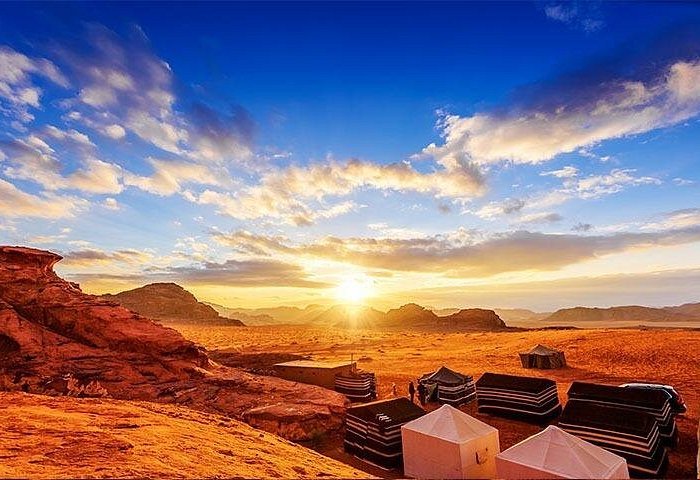
As the sun began to sink, we made our way toward our desert camp. The tented camp, run by a local Bedouin family, consisted of cozy, low-lit lodges patterned in traditional stripes. Before dinner, Khalid led me to a scenic viewpoint to watch the sunset over the dunes. Few things compare to a Wadi Rum sunset. The sky transformed into a palette of flaming orange, dusty rose, and deep purples. The cliffs glowed like embers, and the sand shifted tone with every passing minute. It was a performance of light—gentle, mesmerizing, unforgettable.
Dinner was a feast cooked in a zarb, an underground Bedouin oven. When the food was lifted from beneath the sand, the aroma of slow-cooked lamb, roasted vegetables, and fragrant spices filled the air. We ate under a canopy of stars so bright they looked close enough to touch. There was no city noise, no fog of everyday worries—only the crackle of the fire, distant calls of desert foxes, and warm conversations that didn’t need many words.
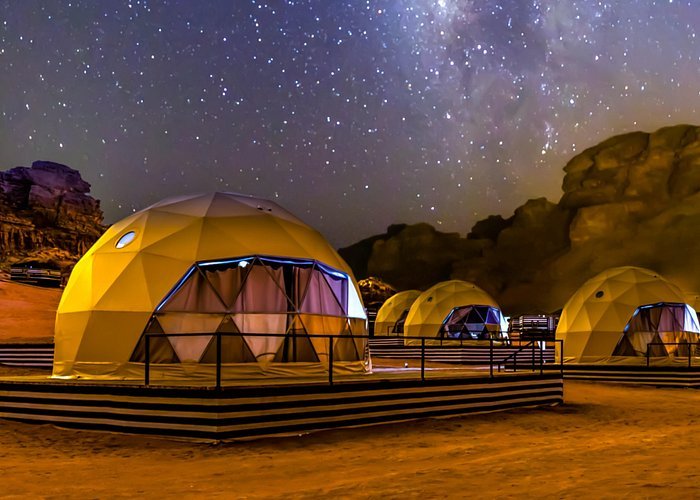
Later that night, I walked a little away from the camp and lay back on the cool sand. The Milky Way stretched across the sky like a celestial river. A soft breeze swept across the desert, carrying with it a peaceful quiet I had never experienced anywhere else.
Wadi Rum isn’t just a place to visit; it’s a place that lingers with you long after you leave. Its silence teaches you to listen. Its vastness invites reflection. Its beauty reminds you that the world is still full of wonder—ancient, untouched, and waiting for you to discover it.