






For eleven months of the year, Valencia is a city of particular beauty — the City of Arts and Sciences gleaming white against Mediterranean sky, the old town’s baroque church towers presiding over orange-tree squares, the Turia riverbed converted into a fourteen-kilometre park running through the city’s heart. It is handsome, liveable, and quietly underestimated relative to the Spanish cities that attract more international attention.
Then March arrives. And Valencia becomes something else entirely.
Las Fallas — held every year from March 1st to March 19th, culminating on the Feast of Saint Joseph — is one of the most extraordinary public art events in the world. It is also one of the loudest, most pyrotechnic, most visually overwhelming festivals in Europe, and the one that most travellers who have experienced it describe, without exception, as unlike anything they have previously encountered. UNESCO recognised it as Intangible Cultural Heritage of Humanity in 2016. The recognition was deserved and also, somehow, inadequate to the actual experience of being inside it.
What Las Fallas Actually Is
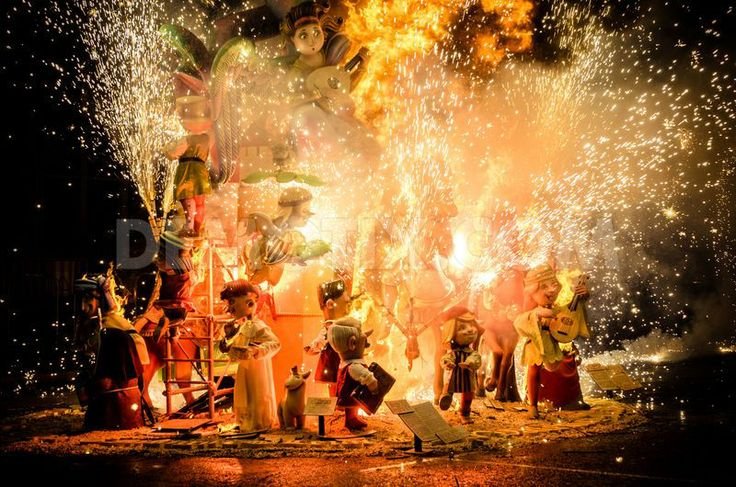
Las Fallas began, in its earliest form, as a carpenter’s tradition. Valencian craftsmen marked the feast of their patron saint — Saint Joseph, patron of carpenters — by burning the wooden stands they had used to hang their lamps during winter. Over centuries, the tradition accumulated layers of artistry, satire, community identity, and competitive ambition until it became what it is today: a citywide installation of monumental satirical sculpture, built over the course of a year, displayed for five days, and then burned to the ground in a single night.
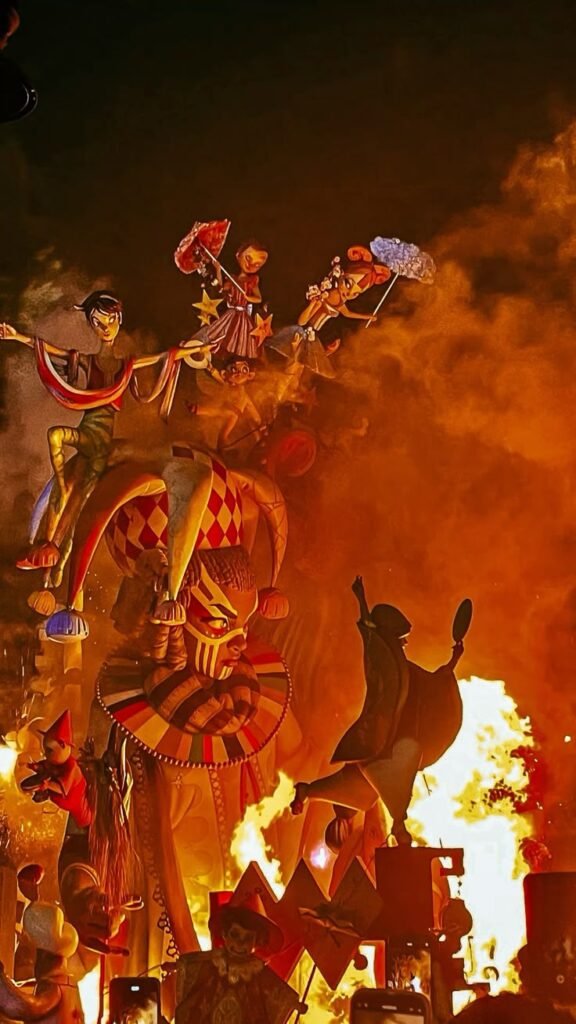
The sculptures — called falles — are the centrepiece. Each of Valencia’s approximately 400 neighbourhood commissions spends the preceding year designing and constructing a falla: a towering, multi-figure sculptural composition built from wood, polystyrene, and papier-mâché, rising anywhere from three to thirty metres in height, depicting satirical scenes that target politicians, celebrities, social trends, and cultural absurdities with a specificity and irreverence that has been the festival’s intellectual signature for generations.
The figures are painted with the skill of master craftsmen — the artistes fallers, whose workshops produce work of genuine artistic ambition. The faces have expression. The scenes have narrative. The satire has edge. Walking among the falles during the five days of their display is to move through an open-air museum of political and cultural commentary that changes entirely from neighbourhood to neighbourhood, from the monumental civic commissions in the central squares to the smaller, stranger, more personal constructions tucked into residential streets where local jokes and local characters dominate.
The Noise That Becomes the Weather
Las Fallas is not only seen. It is heard, felt, and smelled, in ways that alter the city’s entire sensory atmosphere for three weeks.
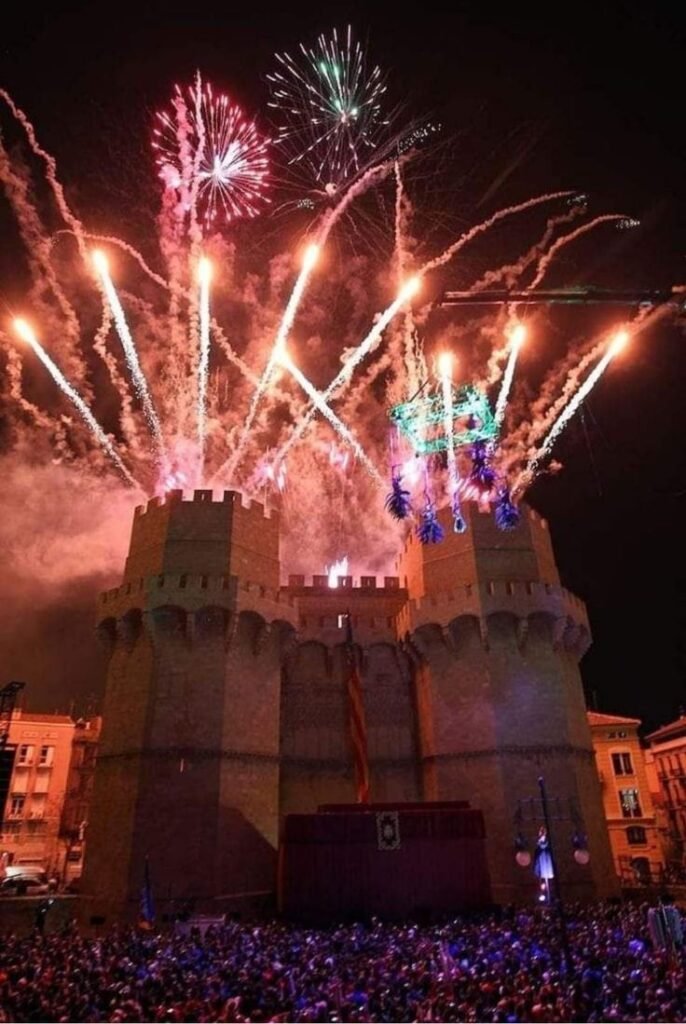
The mascletà — a daily choreographed fireworks display fired at precisely 2pm in the Plaza del Ayuntamiento — is the festival’s daily heartbeat. It is not a visual display. It is a percussion event. The mascletà is designed specifically for sound: sequences of firecrackers escalating in density and volume until the air itself seems to vibrate and the chest cavity resonates with a physical pressure that is simultaneously alarming and, once the initial shock passes, deeply exhilarating. Valencians stand in the square with their faces turned upward and their mouths slightly open — the instinctive response to a sound that the body doesn’t quite know how to categorise.
Around the city, throughout the day and into the night, children and adults fire petards — individual firecrackers — from street corners, doorways, and passing scooters, with a casualness that makes the entire urban environment feel loosely, joyfully explosive. First-time visitors are advised to carry earplugs. Veterans carry them because they learned the hard way.
The smell of gunpowder hangs permanently over the city from March 15th onward. It becomes, within a day or two, indistinguishable from the smell of the festival itself.
La Cremà: The Night Everything Burns
The final night of Las Fallas — March 19th, La Cremà — is when the festival completes its logic. Every falla in the city, every month of artistic labour, every painted face and satirical figure, is set alight. Four hundred fires across Valencia, starting at midnight, burning through the early hours. The city’s fire department — present at each site, managing the burns with practiced efficiency — allows each neighbourhood to light their falla in sequence. The neighbourhood gathers. The music plays. The falla burns.
The heat from a large falla is intense enough to be felt from thirty metres. The largest central commissions — the ones that have cost hundreds of thousands of euros to construct and taken an entire year to build — take over an hour to burn completely. The crowd watches. Some cry. Most cheer. The ashes cool by morning.
One falla is saved each year. The ninot indultat — the pardoned figure — is selected by public vote from among the thousands of individual figures created across all the commissions, and preserved in Valencia’s Museo Fallero rather than burned. It is, in its way, the most coveted artistic recognition in the festival: survival, in an event built around magnificent, deliberate destruction.
The Community That Makes It Happen
Las Fallas is not produced by a government or a tourism board. It is produced by Valencia’s neighbourhood commissions — the comissions falleres, of which there are nearly 400, each comprising hundreds of local members who pay annual dues, attend meetings throughout the year, select their artistic team, commission their falla, fundraise, organise, and ultimately stand together watching it burn.
The falla commission is, for many Valencians, the primary community structure of their lives — more socially binding than any other civic institution. Membership passes through families across generations. The falla’s theme for the coming year is debated and decided collectively. The children of the commission are dressed in traditional Valencian costume and presented as falleres during the festival’s floral offering — the Ofrena — in which hundreds of thousands of flowers are arranged on a vast wooden structure to form the image of the Virgin of the Forsaken over two days of continuous installation.
The Ofrena alone — 700 tonnes of flowers assembled by costumed participants over 48 hours in the Plaza de la Virgen — is, before any falla is lit, one of the most extraordinary collective acts of public creation in Europe.
How to Go
Las Fallas runs March 1st to 19th annually, with the most intense activity concentrated in the final five days from March 15th. Valencia is served by direct flights from across Europe and connecting services via Madrid and Barcelona from further afield. The city’s high-speed rail connections from Madrid (90 minutes) and Barcelona (three hours) make it easily accessible by train.
Accommodation books out months in advance for the final week — March 16th to 19th in particular. Book early, or consider staying in a nearby town and commuting in by train. The city’s public transport runs extended hours during the festival.
Bring earplugs. Wear clothes you don’t mind smelling of gunpowder. Allow more time than you think you need in each neighbourhood. And on the night of March 19th, find a falla to stand beside, stay until it is fully alight, and understand — watching a year’s work become fire in twenty minutes — why the people who built it are, simultaneously, already planning the next one.